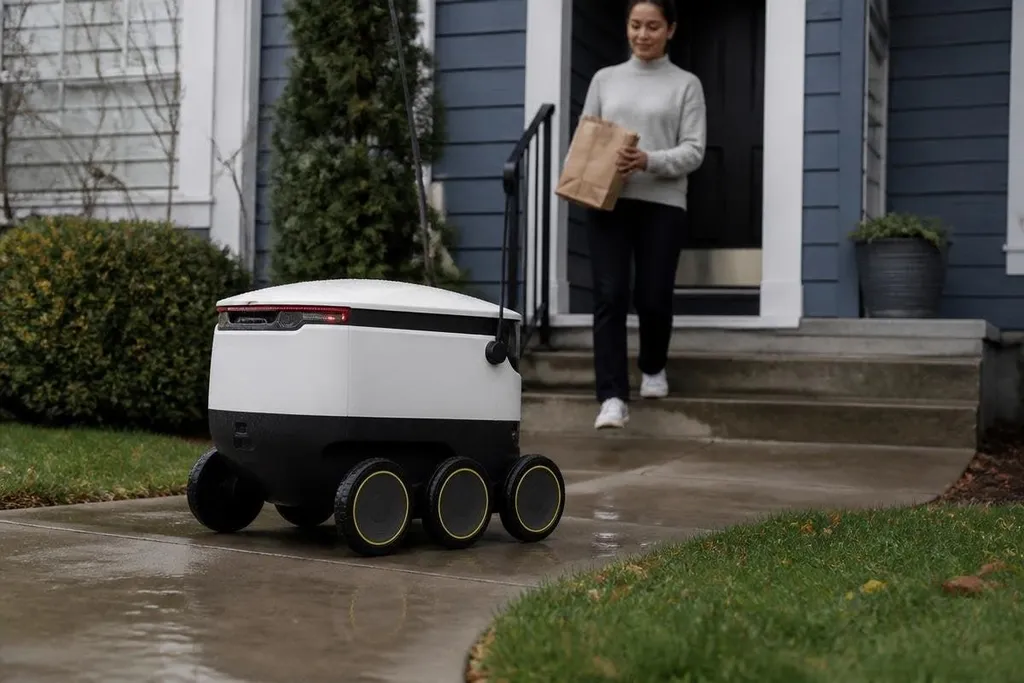
A grocery delivery robot can handle a planned route, but the final metres often decide whether the service works. Kerbs, doors, people, pets, bad weather, and missing customers turn a short trip into a full operating problem.
For a store or delivery operator, the useful question is not whether the robot can move. It is whether the robot can complete the handoff safely, repeatably, and at a cost that fits the order.
- The route is only half the job: the robot must reach the right door and stop in a safe place.
- The handoff sets the limit: access, identity checks, temperature control, and customer timing all matter.
What the robot must do between store and home
A grocery delivery robot usually combines cameras, other sensors, mapping software, motors, and a battery. Its software builds a view of the path, detects obstacles, and changes the route when a person, bicycle, vehicle, or temporary barrier blocks the way.
That sounds straightforward until the robot leaves a controlled site. Public paths may have uneven surfaces, narrow sections, parked vehicles, road crossings, and people who do not expect a machine to stop nearby. The robot has to move slowly enough to protect people while still completing enough orders to make the service useful.
The payload also shapes the job. Groceries can include heavy bottles, fragile produce, chilled items, and bags with different sizes. A storage compartment that works for a small order may be awkward for a larger one, while a full compartment adds weight and changes how the robot brakes and climbs a slope.
The doorstep is a systems problem
The trip ends when the customer receives the order, not when the robot reaches a map point. A delivery can fail because the entrance is locked, the address is unclear, the customer is away, or the robot cannot find a safe place to wait.
The handoff needs a clear process. The customer may open a compartment with a phone, enter a code, or use another identity check. Each method affects speed and access. A process that works for a regular customer may be harder for someone with limited mobility or a weak phone signal.
Cold food adds another constraint. The operator has to control the time between store packing and customer pickup. That can require insulated storage, a time limit, or a return process when the customer does not arrive. Without those details, the robot is only moving a box while the grocery service carries the risk.
Operators comparing grocery delivery pilots need reports that name the robot, store partner, route, and trial date. Robot24.com robotics coverage can tie those details to the customer handoff and measured result, giving the next section a practical starting point: record arrival time and food temperature, then note what happens when no customer answers.
What operators need to measure
A useful trial should record the full delivery, including the tasks that happen before and after the trip. A route that finishes often may still lose money if staff spend too long loading bags, watching the robot, answering customer calls, or collecting failed orders.
The operator also needs to separate robot faults from site problems. A blocked path may point to a mapping issue, while repeated customer failures may show that the handoff process needs a change. Treating every failure as a navigation problem hides the cost of the wider service.
Public operation brings safety duties as well. The robot needs a way to stop, a way for staff to recover it, and a clear response when its sensors cannot read the path. People nearby should be able to understand what the robot is doing without guessing.
A practical buying checklist
Before a grocery operator approves a delivery robot trial, check these points:
- Route limits: define the roads, paths, crossings, slopes, and weather conditions the robot can handle.
- Order fit: test the compartment with the actual bag sizes, weights, chilled goods, and fragile items the store sells.
- Handoff time: measure customer access, missed pickups, returns, and staff help for each order.
- Remote support: record who watches the fleet, how they stop a robot, and how quickly they can recover it.
- Cost per trip: include loading, charging, supervision, repairs, customer support, and failed deliveries.
I'd skip a deployment that measures only successful trips. The useful number is the cost and staff time for every order placed, including the ones that need a second attempt.
Grocery delivery robots may work well on short, known routes with clear access and a simple handoff. The next proof is wider: whether the same service can handle changing paths, mixed orders, and missed customers without adding more human work than it removes.